
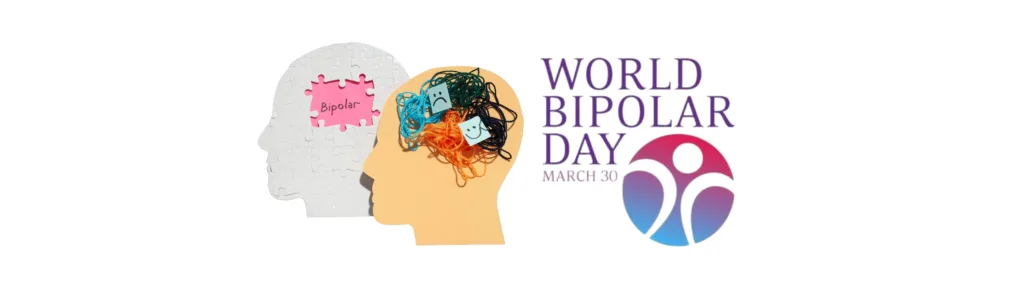
World Bipolar Day is an annual event that encourages people to be more open and to discuss the challenges faced by those living with bipolar disorder. World Bipolar Day is celebrated on 30th March, the birth date of the historical painter Van Gogh, who was presumed to have had bipolar disorder.
However, World Bipolar Day is also an opportunity to raise awareness of the condition and to understand how it may affect those living with it. World Bipolar Day encourages people to share their experiences, engage with peer support groups, take part in awareness campaigns, and challenge stereotypes and misinformation related to the condition.
Let’s Talk About Bipolar Disorder!
Bipolar disorder is a mental health condition (formerly known as ‘manic depression’) that affects a person’s mood. It is a lifelong condition that is managed with prescribed medication and talking therapies.
What is Bipolar Disorder?
There are two main types of bipolar disorder: Bipolar I and Bipolar II, with symptoms including mania or hypomania and depressive episodes. However, bipolar disorder can also be categorised into four different subtypes: Cyclothymia, Rapid Cycling Bipolar, Bipolar with Mixed Features, and Bipolar with Seasonal Features. These include:
Cyclothymia – Episodes of hypomania and depression over a two-year period. Symptoms may develop into Bipolar I or II but may not be severe enough for a diagnosis of either.
Rapid Cycling Bipolar (RCB) – A diagnosis of Bipolar I or II with rapid cycling may be given if symptoms include:
- Episodes of mania or hypomania followed by an episode of depression.
- Stability in mood between episodes of mania, hypomania, and depression.
- Symptoms lasting for days, weeks, or months.
Bipolar with Mixed Features – Often diagnosed as Bipolar I or II with ‘mixed features’. This is characterised by experiencing both depressive and manic/hypomanic symptoms at the same time or in quick succession. This type of bipolar disorder is commonly referred to as ‘mixed bipolar’ or ‘affective bipolar’.
Bipolar with Seasonal Pattern – A diagnosis of Bipolar I or II ‘with seasonal pattern’ may be given if mood episodes are linked to seasonal changes.
What Causes Bipolar Disorder?
There are several potential causes and triggers of bipolar disorder, including:
- Childhood trauma and stressful life events – These can trigger the onset of bipolar disorder.
- Genetics – If a close family member has bipolar disorder, there may be a genetic predisposition.
- Chemical imbalances in the brain – Changes in brain chemistry and activity can contribute to the development of bipolar disorder.
- Substance use – Certain prescribed medications, recreational drugs, and alcohol misuse can act as triggers.
Treatment and Therapy
Bipolar disorder is typically managed using a combination of medication and talking therapies, as prescribed by a doctor.
Medication:
- For mania/hypomania – A doctor may prescribe antipsychotic medication to help manage these symptoms.
- For depression – Antidepressants may be prescribed to treat depressive episodes linked to bipolar disorder.
Talking therapy:
- Individuals with bipolar disorder are often managed under their local Community Mental Health Team (CMHT).
- Cognitive Behavioural Therapy (CBT) and other talking therapies may be offered to help manage and maintain overall well-being.


Case Study – Selena Gomez
The pop princess, Selena Gomez, 32, was first diagnosed with bipolar disorder in 2018 after experiencing an episode of psychosis. During this episode, Gomez said she had heard ‘voices’ and felt paranoid. In a detailed documentary about her life with bipolar disorder, Selena Gomez: My Mind & Me, she explains that being diagnosed with the condition helped her to understand her ongoing depression and anxiety. She also shared how she needed to learn to manage and cope with her mental health in a way that would benefit her, as it “wasn’t going to go away.”
The inspirational young woman expressed how psychiatric help had benefited her and that she continued to need support to learn how to manage her condition. Gomez has also highlighted the need for more people to talk about mental health issues in a way that is open and normalised. Speaking about her own journey, she emphasised the importance of continuing to learn about her diagnosis and “taking it day by day.”