
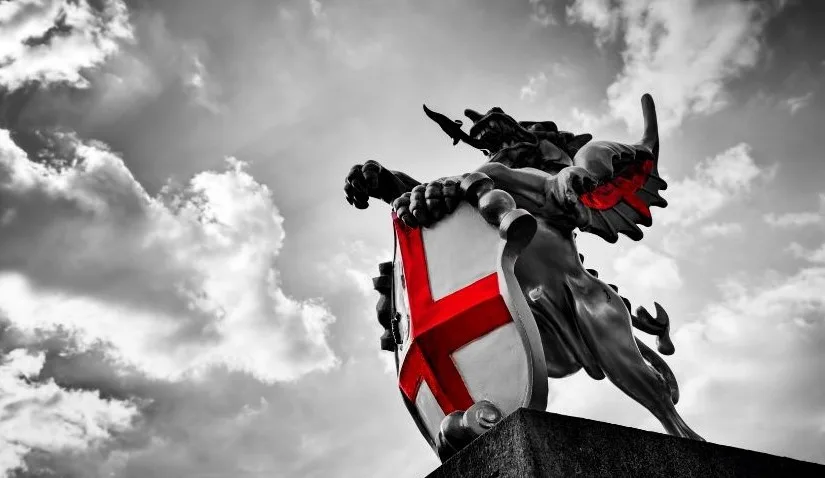
St. George’s Day is a day of feast and celebration for many thousands of Britons, who come together each year on the 23rd of April to celebrate the life and legacy of Saint George, or George of Lydda, who was venerated as a patron saint of the Christian faith many centuries ago.
The 23rd of April is also traditionally accepted as the date in which Saint George’s life was taken in AD 303, as a result of the *Diocletian Persecution, or The Great Persecution, where Saint George refused to reject his Christian faith. Additionally, Saint George is also considered a patron saint in several other countries including Bosnia, Herzegovina, Georgia, Ukraine, Malta, Ethiopia, Spain, and Russia.


Saint George & the Dragon
In history, Saint George is more notably remembered for the legend of ‘Saint George and the Dragon’.
A story in which Saint George rescued a princess from a dragon that had been extorting tributes of livestock and trinkets from villagers and who apparently had a ‘taste for humans’.
The story goes that Saint George defeated the dragon who had been tormenting villagers for several years. When the villagers of Silene (known today as Libya) had run out of precious livestock and trinkets, they were soon having to give up human tributes as a sacrifice. A princess was later chosen as a means for the next offering to the dragon. Saint George came to the rescue of the villagers in Silene and bravely killed the dragon by chopping its head off with his mighty sword, saving the princess from her impending fate.
The dragon’s carcass was then carried out of the city of Silene on four Oxcarts.
Saint George & the *Great Diocletian Persecution
While there is little known information about Saint George, or George of Lydda as he was formerly known.
It is understood that he was of Cappadocian Greek origin and was a soldier in the Roman army and a member of the Praetorian Guard for the Roman Emperor Diocletian. During Diocletian’s role as the Roman Emperor, many thousands of Christians were persecuted due to their faith as a result of the Diocletian Persecution, or the Great Persecution. Diocletian and others including Maximian, Galerius, and Constantius, issued a series of statutes.
This meant that Christians were obligated to reject their religious beliefs and to sacrifice themselves to Roman Gods. Failure to comply with these rules meant that many thousands of Christians were faced with imprisonment or execution.
Saint George also faced persecution for his faith in Christianity during these times and was subsequently executed as a result in AD 303

How we celebrate St. George’s Day in England
With bunting and banners, St George’s Day is a special day for British folk, where we remember our patron saint, Saint George of Lydda.
A very brave man who became one of the most venerated saints and megalomartyrs in Christianity. However, nothing is quite British without a good old afternoon tea, consisting of freshly made sandwiches and deliciously divine cakes, with a proper brew to soak up all those tasty delights.
All in event, as we come together to celebrate the life and legacy of our patron saint St. George of Lydda on the 23rd April each year.

Looking for the latest news updates? Explore more here: www.phxtraining.co.uk/news